
Voice cloning can now reproduce your cadence, your pauses, and your breath patterns with enough accuracy that your longtime listeners will not catch the difference — so the real question is not whether the technology works, but who owns what it produces.
Voice cloning for podcasters has moved from novelty to genuine workflow tool faster than most creators processed what they were agreeing to. If you have published two to four years of episodes and you are weighing whether to use a synthetic voice to scale your output, the decision is not a creative one. It is a legal one, and it is happening right now inside terms of service documents most people never finish reading.
The appeal is real: voice cloning solves a problem podcasters actually have, and dismissing it as a gimmick misses why exhausted creators are saying yes
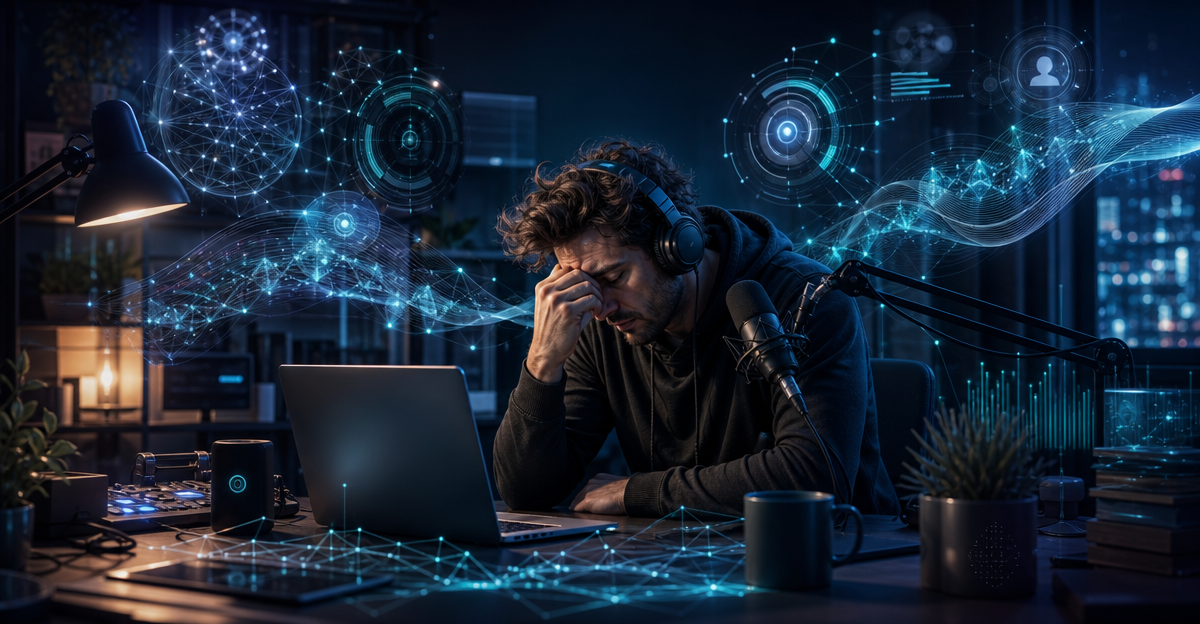
The problem is not laziness. Independent podcasters with multi-year back catalogs consistently report the same breaking point: production keeps expanding while recording time stays fixed. You still have to be on mic, fully present, for every episode — and that ceiling hits hard around year three.
Voice cloning offers something specific: the ability to produce supplemental content — episode recaps, translated versions, ad reads in multiple languages — without booking additional recording sessions. For a solo creator doing everything alone, that is not a gimmick. That is survival math.
The pattern across creator communities shows that the people saying yes to voice cloning tools are not the ones chasing novelty. They are the ones who have already tried every other shortcut and run out of hours. Dismissing their decision without understanding that context is how most tool reviews miss the point entirely.
What you are signing is not a feature agreement — the fine print on voice licensing creates rights that outlast your relationship with any platform
When you submit a voice sample to train a cloning model, you are not just enabling a feature. You are creating a licensed asset, and the terms governing that asset vary dramatically depending on which platform holds the model. Some agreements grant the platform a perpetual, royalty-free license to use the voice profile for purposes that go well beyond your original use case.
The word perpetual is doing enormous work in those contracts. It means that even if you cancel your subscription, close your account, or the company gets acquired, the voice profile you created can persist under the terms you agreed to at signup. Most podcasters do not read that clause because they are focused on the monthly price, not the exit terms.
Before signing anything involving voice cloning, look for three specific clauses: whether the license survives account termination, whether the platform can sublicense your voice profile to third parties, and whether you retain the right to request deletion of the trained model. If any of those three questions are not answered clearly in the agreement, that absence is your answer. Understanding how creative licensing works before you encounter it in a contract is the difference between a tool and a trap.
Spotify’s verified badge and cloning ban reveal the tension: platforms want trust signals and synthetic scale at the same time, and creators are caught in between
Spotify’s ban on AI-generated voice content from its verified podcast program is not a principled stance against synthetic audio. It is a product decision about which trust signals matter to advertisers. Verified badges exist to tell brand buyers that a show has a real, identifiable human behind it — and that human is accountable in ways a voice clone is not.
At the same time, Spotify has invested in AI-powered tools for creators on its own platform. The message being sent is not that voice cloning is wrong. The message is that Spotify wants to control where synthetic audio appears and under what conditions — and the verified badge is the mechanism for drawing that line in a way that protects their ad business, not yours.
For an independent podcaster, this creates a specific bind. If you use voice cloning to scale your output and your show is in Spotify’s verified program, you are risking that status. If you are not in the verified program, you may be invisible to the advertisers who pay rates that make independent podcasting financially sustainable. The platform is setting the terms of legitimacy, and voice cloning is where that leverage is being exercised most visibly right now.
Three podcasters who used voice cloning tools share what changed six months later — the workflow wins, the audience drift, and the moment it felt wrong
The pattern that surfaces consistently from creators who have used voice cloning tools for six months or more is this: the workflow wins are real and measurable in the first ninety days, and the audience drift becomes real and unmeasurable after that. Translated episodes went out faster. Ad reads got done in a fraction of the time. The production calendar stopped being the enemy.
Then the emails started. Not complaints, exactly — more like questions. Long-time listeners writing to ask if something had changed in the show. Whether the host was okay. Whether they had moved production overseas. The listeners could not name what was different. They just knew something was.
The moment that consistently gets described as the inflection point is not a dramatic one. It is usually a listener interaction — a live event, a voice message, a genuine exchange — where the creator realizes that the audience relationship they spent years building was built on something the clone cannot replicate. Not the voice. The specificity of being a particular person, in a particular moment, saying something unrepeatable. That is what voice cloning for podcasters cannot actually package, and six months is about how long it takes to notice what is missing.
The question is not whether to clone your voice but whether you have decided what your voice is actually for
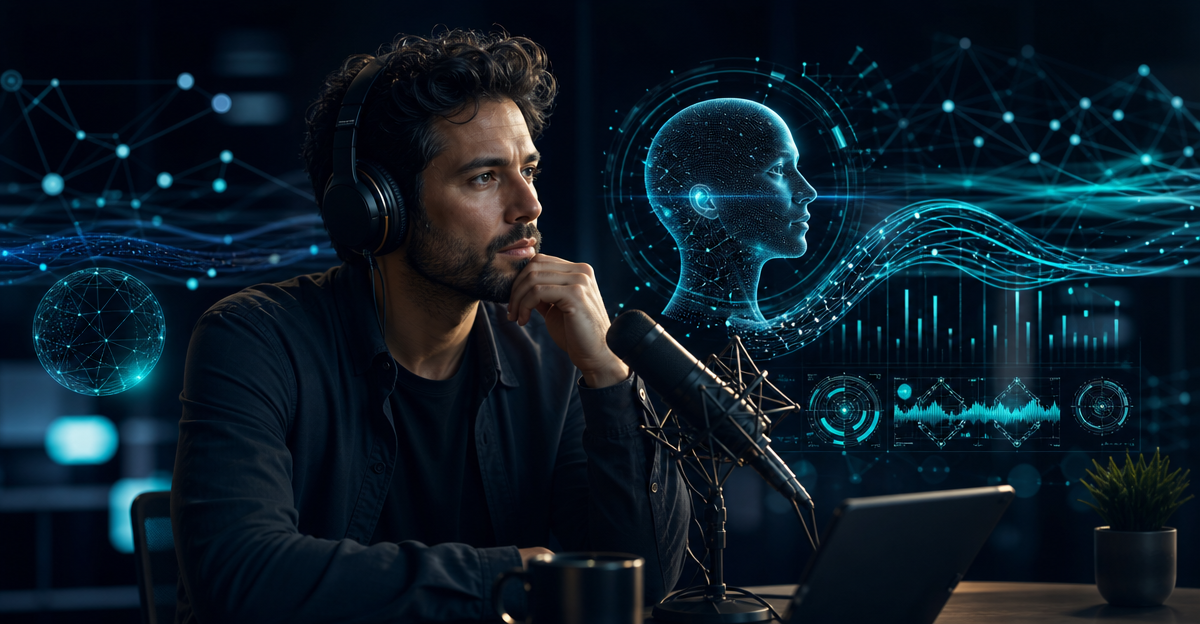
Before you sign a voice licensing agreement, answer one question with precision: what is your voice producing for your audience that cannot be produced any other way? If the honest answer is primarily information, voice cloning is a reasonable tool under the right contract terms. If the honest answer includes trust, intimacy, or the sense that someone specific is talking directly to the listener — that is the asset you are being asked to commodify, and the platforms offering to help you scale it have different incentives than you do.
The practical line to draw before any signature is this: refuse any agreement that does not include an explicit model deletion clause, a prohibition on sublicensing your voice profile, and a termination provision that ends the license when you end the relationship. Those three clauses are not standard. Asking for them will tell you immediately whether the platform views you as a partner or a data source.
Voice cloning for podcasters is not the problem. Signing away the rights to your voice without reading what that means — then discovering it three months after you needed to know — is the problem that this piece exists to prevent. Subtraction before addition: know what you are giving up before you calculate what you are gaining.